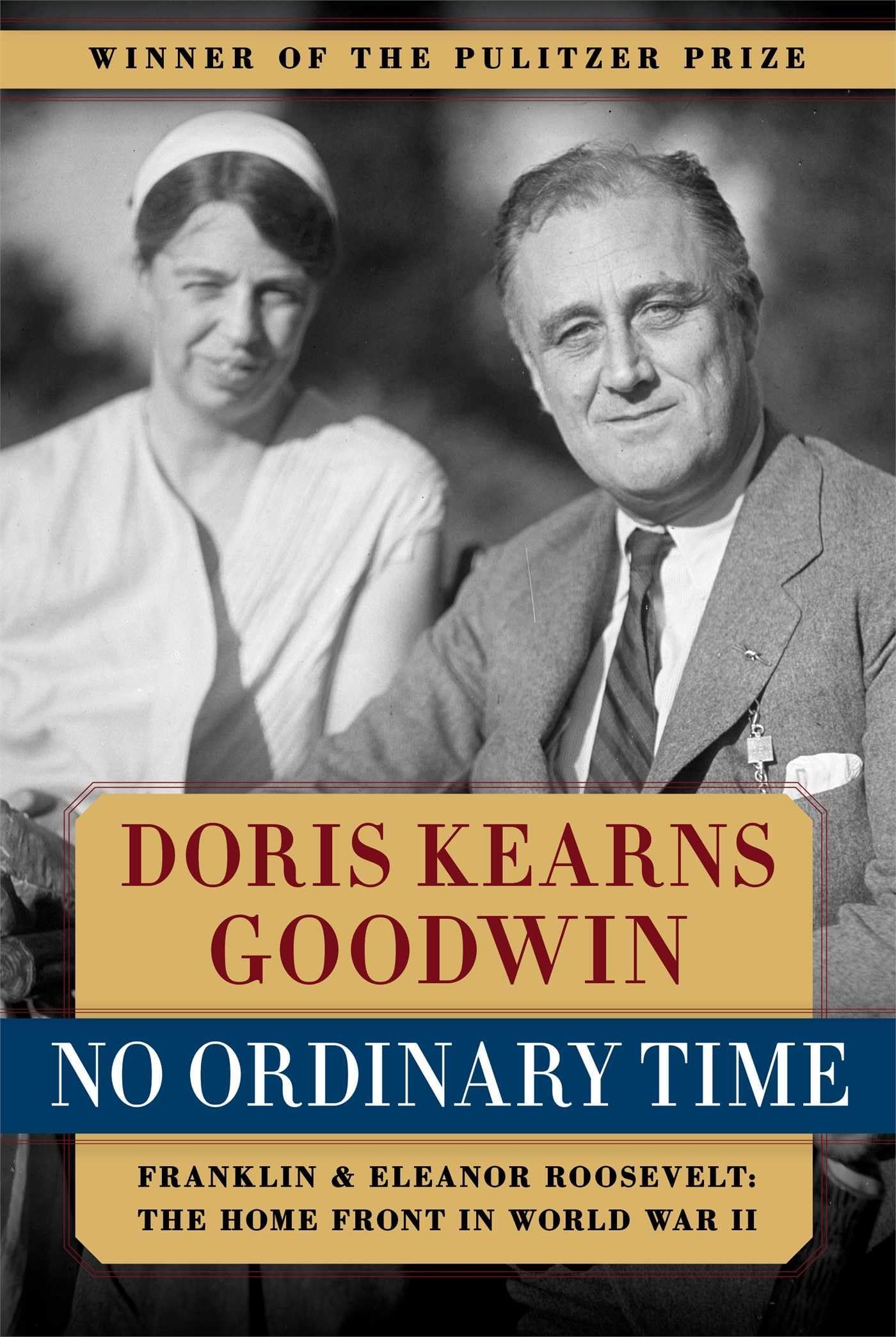
No Ordinary Time: Franklin and Eleanor Roosevelt: The Home Front in World War II
Product ID: 1609965
Buy anything from 5,000+ international stores. One checkout price. No surprise fees. Join 2M+ shoppers on Desertcart.
Desertcart purchases this item on your behalf and handles shipping, customs, and support to Senegal.
Doris Kearns Goodwin’s Pulitzer Prize–winning classic about the relationship between Franklin D. Roosevelt and Eleanor Roosevelt, and how it shaped the nation while steering it through the Great Depression and the outset of World War II. With an extraordinary collection of details, Goodwin masterfully weaves together a striking number of story lines—Eleanor and Franklin’s marriage and remarkable partnership, Eleanor’s life as First Lady, and FDR’s White House and its impact on America as well as on a world at war. Goodwin effectively melds these details and stories into an unforgettable and intimate portrait of Eleanor and Franklin Roosevelt and of the time during which a new, modern America was born.


| Dimensions | 6.13 x 1.6 x 9.25 inches |
| Edition | First Edition |
| Isbn 10 | 0684804484 |
| Isbn 13 | 978-0684804484 |
| Item Weight | 2.23 pounds |
| Language | English |
| Print Length | 768 pages |
| Publication Date | October 1, 1995 |
| Publisher | Simon & Schuster |
User
No Ordinary Historian
This book is simply epic in scope and a masterpiece in style and content. It is spectacularly well researched and written with the apparent intent of reaching a very broad audience, to include not only WWII buffs but enthusiasts of American history and extraordinary biography. The depth of background research suggests that the author dedicated decades of her life to studying nothing but Franklin and Eleanor Roosevelt and their associates and rivals. How Ms. Goodwin managed to write other superb books, make innumerable appearances in TV, and raise a family will probably continue to astound her readers for decades to come.That said, assorted winds were blowing at her back. First is the undeniably fascinating focal point of the president and first lady, the likes of which this country has not seen before or since. Far from being merely the prototypical New Dealer, Goodwin reveals FDR as the penultimate political tactician. He was a consummate master of reading the public's readiness to embrace social and political change, including the launching of New Deal programs intended to put Depression era America back to work, the transition to a war time production footing, and incremental steps toward racial equality and integration, including such nearly impenetrable bastions as the United States Navy where for decades, blacks were overwhelmingly more likely to serve as mess workers than sailors. FDR's soul mate, the irrepressible agent of social welfare, Eleanor Roosevelt, is revealed as a once the damaged product of a troubled childhood and a lifetime juggernaut, a virtually tireless advocate for the poor, women, minorities and anyone else who was otherwise disenfranchised.Perhaps above all else, including a riveting account of how the U.S. finally came to put its full might behind the war effort, "No Ordinary Time" paints an incredible complex and subtle relationship between FDR and the first lady. This was a love affair perhaps unlike any in history, mostly for the better, but at times for the worse. At their best, they were tireless advocates for the nation's and each others' needs, causes and passions. At their worst, they were a couple who largely lived apart, both physically and spiritually. Their extra-marital relationships were probably unique, not merely because they happened over a period of decades, but in their idiosyncratic nature. FDR had the equivalent of at least two full blown extramarital relationships, while Eleanor was the subject of a romantically obsessed female reporter and the fount of an obsession of her own making with a man young enough to have been her son. One is led to believe that FDR and Eleanor's combined levels of extraordinary energy and sociopolitical passion were directly fueled by their relationships with other men and women across most of their adult lives.This book is so richly detailed and nuanced that one could ignore (at their great loss) all the psychological intrigue and simply focus on the most distressing and fascinating war in history. The description of how the U.S. transitioned from an isolationist nation wishing to avoid involvement in another world war at all costs to the driver of the Allied effort is intriguing. If for no other reason, one can devour this book for its revelations over how we turned a consumer nation good at making cars, trucks, washing and sewing machines to a crushingly effective manufacturer of warplanes, tanks, ships, guns and ammunition.Read this book for the psychological, political, or economic content. You can not possibly miss out on a fantastic learning experience and yes, this truly was the Greatest Generation.
User
A remarkable book as much about America today as the history it spans
This is a remarkable book about one of America’s most remarkable power couples during a truly remarkable period in world history. And it’s told, delightfully and effectively, largely through narrative dialogue. One can only imagine the hours of research that required; much less a level of access that few other historians could possibly command.The writing is magnificent, and somehow Goodwin manages to bring us up close and personal with the Roosevelts while simultaneously coloring in all of the contextual detail of a world at war. It is really quite fascinating to think of the sheer scale at which world leaders were forced to think at the time. The petty disputes we seem to be obsessed with today quickly recede into irrelevance by comparison.Several things struck me quite intensely. The first is the discovery of just how divided the US was on the brink of entering the war. It is easy, and perhaps tempting, to believe that our politics have never been more divided than they are today, but that is not an entirely accurate assessment.While that may or may not be reassuring to anyone, it is a source of optimism if you follow the story through. Wherever you sit on the political spectrum today, the story of Wendell Wilke’s support for conscription and for the support of Great Britain, which he had to assume would cost him the election, was truly indicative of one of those great moments in American history when a single powerful individual put the interests of his country and his conscience above his or her own.The second thing that struck me was a reminder of just how fragile history is. While we tend to look back in time through the perception that history was somehow fated, it never is. A change in direction one degree one way or the other and history would have followed a completely different path. And, more often than not, the path that it did follow was not of any one person’s design or choice.It is not, however, a path defined by sheer happenstance. One unexpected result of the book, for me, is a greater appreciation of the civic duty each of us shares. We must vote. We must speak. We must get involved. While I often feel that my own voice is lost in the sea of shouting that is political discourse today, Kearns gave me a greater appreciation of how history really works. It’s not my voice that matters. But it is my voice, in a chorus with others, which can change history. And for that awakening I am truly grateful.The great strength of democracy is that government leaders ultimately hold no power without the support of the people. But which is the chicken and which is the egg? While Roosevelt consciously waited for the support of the American citizenry before escalating the US commitment to war, it is also clear that he was very deliberately shaping that support toward his own agenda. While that deceptive use of government power may be justified by the fact that his was the just agenda, what if it wasn’t?World War II was the medium for vast social, economic, and migratory change in America. Some of it, particularly relating to the treatment of people of color and gender norms didn’t go far enough and there is much work to be done yet today.Some of it went too far. Before the war America was built on a foundation of small business. The war launched the rise of the large corporate institution and the military-industrial complex. It’s a particularly important development because of the power of the state to shape opinion and policy. He/she who controls the political process, which is clearly in the hands of the people and the institutions who control our wealth today, controls, to a large extent, public opinion. It’s not, in other words, a fair fight between opposing ideologies. The money, in this case, has the upper hand.There is little question that the dog-eat-dog, me-centric way of life we know today would have been unrecognizable, and greatly disappointing, to the Roosevelts. They spoke openly about a post-war America in which the right to make a decent living, access to health care, and the integration of the rights of labor and management, would be firmly established. It is a we-centric perspective that is foreign to the individualistic ideology of our current political leadership.It’s a long book. But it’s not repetitive. And while it felt like an accomplishment when I turned the last page, it was a feeling of great satisfaction. This is my first book by Kearns but she is truly one of the great historians and the great writers of our era.In the end, it is a period of American history that we should all study. Not just because it was an important era in history but because it has so much to teach us, both good and bad, about the America we live in today and where we should go from here.
User
"No Ordinary Time: Franklin and Eleanor Roosevelt and the Home Front in World War II." The title says it all.
The title is very apt. "No Ordinary Time: Franklin and Eleanor Roosevelt and the Home Front in World War II."When Hitler and the Nazi war machine start to invade and occupy one European country after the next, Great Britain stands alone against the Nazi hoard. The U.S. Congress is conservative; the country is isolationist with no standing army, no navy or air force and no stomach for what is going on in Europe. Added to that a deep distrust of how the U.S, was dragged into the Great War under President WoodrowWilson. And FDR has to figure out ways to help Britain, keep the country out of the war while realizing that having the buffers of the Atlantic and Pacific oceans isn't enough given the Axis powers and the Japanese.The book proceeds chronologically. It is well researched covering not only national politics but describes in depth the "family" and personalities who lived at the White House in addition to FDR and Eleanor Roosevelt It is filled with anecdotes and facts about industries throughout the country, labor situations, racial divides, segregation, prejudice of other kinds, attitudes toward women including their place in the home, poverty, etc. And goes from chilling descriptions of the Great Depression's hold on people to the U.S.'s re-emergence as an industrial and military powerhouse.This book won Doris Kearns Goodwin the Pulitzer Prize. It came before her book on Abraham Lincoln, "Team of Rivals" which I feel is superior to "No Ordinary Time," which I read recently for the second time. On a human level, it is fascinating exploring over time manypersonalities, both public and private, revealing FDR's affair in 1918 with Lucy Mercer that almost destroyed the marriage between FDR and Eleanor Roosevelt, as well as her emergence both as a public figure in her own right and as an eye and ear for the President. I found it particularly engrossing once the American military entered the war full scale. It also is a fascinating evolving portrait of FDR himself and, to a somewhat lesser extent, Churchill. Others may find other more fascinating and compelling aspects to this story such as the tremendous emergence of women in the production of aircraft, tanks, munitions, battleships etc. or in integration of blacks and whites in the Army, Navy and Air Force.This is a page turner, an utterly engrossing book that will fill you with awe and pride in an enormous story that will remain in your memory long after you've completed reading it. It is that good.Recommended unqualifiedly. .
User
No Ordinary Narrative
Throughout the book, No Ordinary Time: Franklin and Eleanor Roosevelt: The American Home front during World War II, the Pulitzer prize winning author Doris Kearns Goodwin strives to depict Franklin and Eleanor Roosevelt not just as political powerhouses of the mid twentieth century, but as actual human beings with genuine emotions. Goodwin attempts to bridge the gap between the personal happenings of the Roosevelt family and the historical events of the Second World War.Through working for Lyndon B Johnson and teaching a course at Harvard University titled, "The American Presidency," Goodwin has acquired a vast experience with understanding and interpreting the actions of Presidents. While working under Lyndon B Johnson as a White House Fellow and an assistant, Goodwin acquired a new found interest in the diverse personalities surrounding the president; this experience played a huge part in her interpretation of FDR's personal assistant Missy Lehand. Although many biographers overlook the influence of personal assistants, Goodwin consistently emphasizes the importance of Missy on the daily life of President Roosevelt.As the book opens at the beginning of FDR's third term, the reader is presented with a truly bizarre menagerie that is known as the Roosevelt White House. Franklin and Eleanor have separate bedrooms, Lorena Hickcock, Eleanor's "special friend" lives in the bedroom across the hall from the first lady. Sara Roosevelt, Franklin's mother, is frequently on hand, as are Harry Hopkins, Franklin's advisor, Princess Martha of Norway, whom FDR shares a very intimate relationship with, and the list of colorful characters goes on. Yet, Goodwin assures us that all of these relationships are perfectly straightforward and innocent. The book is essentially told through the perspective of those surrounding Franklin and Eleanor; thus giving the reader the feeling that they are also a part of the hustle and bustle of the White house. Due to the large amount of secondary characters, Goodwin fails to give certain personalities justice in their descriptions; therefore it is often difficult to keep each person straight. Lucky for Goodwin, the diaries and letters of the hundreds of Roosevelt's companions provide a strong basis for writing a book about the president. The book is made up of personal accounts of what living in the White House was like. Goodwin does a beautiful job tying these accounts together and her use of primary sources really enhances the book. Although Goodwin does not recreate hypothetical discussions; the usage of diary entries really makes the stories come to life. Through reading, it becomes obvious that Roosevelt needed to have people surrounding him at all times. Without the assurance and advice of his closest companions Roosevelt could not have functioned, never mind governed the largest political power of the time. Goodwin attributes Roosevelt's need to be in the company of a variety of people with his overbearing mother and her influence on his childhood.The Narrative switches off between the comings and goings in the Roosevelt White house and the major events shaping World War Two. Goodwin eloquently synthesizes the two making it easy to see a direct correlation between FDR's decisions and the many outcomes of the war. Due to the fact that Goodwin only briefly describes Franklin and Eleanor's childhood, there are many dots left unconnected. It would be easier to understand Franklin's many idiosyncrasies if the reader had a background on his early life. Instead Goodwin decides to start the book at the pinnacle of FDR's political career, consequently robbing the reader of an in depth understanding of how Franklin Roosevelt became the President. Goodwin shies away from the controversies surrounding Eleanor's sexual preferences, and the names Lillian Faderman and Blanche Wieson Cook are never brought up (CANON). It seems that the author takes great pride in exposing Franklin Roosevelt for the ladies man that he truly was but only addresses certain aspects of Eleanor's life.Furthermore, Goodwin chooses to place emphasis on the luxurious lives of the Roosevelt's, rather than the disenfranchised American common man. It becomes easy to forget the unstable state that the American people were faced with at the time; one has to remember while reading that not every family has an estate in Hyde Park or copious amounts of virtually everything. One needs to keep in mind that, eight years of the New Deal has still left the country with a seventeen percent unemployment rate. However, Goodwin assures the reader that the New Deal has been a resounding victory. Now, a second crisis approaches, World War Two, which is even more fearful than the Depression. Yet, Goodwin describes the situation as if there was no chance of the Nazis winning and holding power over the World. Little is said about the personal sacrifices individual American's were making every day on the home front. Instead Goodwin focuses on the battles happening overseas and the president's reactions to pivotal events. The average American people of the time are viewed merely as helpless beings in need of rescuing by Franklin's policies and Eleanor's social endeavors.When FDR faced a decision that fairly few Presidents' have ever contemplated, the question, "Should I run for a third term?" George Washington was one of the few, who could have actually won a third term, but he considered it more important that the Nation be governed by laws and not men, therefore he stepped down from the presidency. Following his example, no other President, with the exception for Theodore Roosevelt, had made the decision to run for a third term. Nevertheless Goodwin barely acknowledges the fact that FDR's decision to run was a significant step on the way to the Imperial Presidency. Later, when FDR actually runs and wins a fourth term in office, Goodwin, not only ignores this subject but she continues to overlook the fact that Roosevelt was a dying man, with a very slight chance of finishing his term. In Roosevelt's eyes it was an, "act of extraordinary irresponsibility to put the country in a position where it would be governed by a virtual unknown in time of war." But by this time, as one observer remarked "[...] he had ceased to be a person; he was simply the president. If something was good for him, it was good; if it had no function for him as president, it didn't exist." This mindset was exactly what George Washington did not want in the President of the United States to have. Yet, Goodwin neglects this "minor" indiscretion and plays off FDR's power hungry need to be in control as merely a trait that made him a great leader.Personally I enjoyed reading, No Ordinary Time; I now have a newfound fascination with the relationships between first ladies and the presidents. I think that Goodwin did a wonderful job in depicting the Presidents personality and his unique way of going about things. The author's use of primary sources, especially the letters between Eleanor and her daughter Anna really helped me look at the Roosevelt family in a new light. Although at some points Goodwin left me wanting to know more about certain topics like internment camps, I got the feeling that Goodwin purposely omitted certain facts because of her own personal adoration for FDR. In addition I wish that the author would have discussed Franklin's childhood and early political career, more in depth. I really liked how Goodwin described what was going on in the White house and then immediately jumped to the daunting situation overseas. The organization style is what makes this book so profound; it is obvious that Doris Kearns Goodwin put a lot of thought into the order of each paragraph. Furthermore, through reading this book it becomes obvious that the modern day presidency would not exist without the influence of Franklin Delano Roosevelt. FDR essentially revolutionized the office of the presidency and provided a transition between the early twentieth century presidents and what we see the executive office as today. I would recommend this book to anyone who claims that FDR is the worst president of all time, because this book really shines a positive light on FDR's third and fourth term on president and it provides a deep look into the emotions of the thirty second president of the United States.All in all the Book, No Ordinary Time: Franklin and Eleanor Roosevelt: The Home Front in World War Two, provides the reader with deep insight into the inner workings of the White house at one of the most pivotal times in History. Goodwin really serves her purpose of both bridging the gap between the White house and World War Two, and providing insight into the human inside one of the most influential leaders of the twentieth century.
User
No Ordinary Book
I first became familiar with Doris Kearns Goodwin through her television appearances as a Presidential historian. I'd long admired the Roosevelts, and ordered this book to learn more about them. I still admire them, but I found the insights into their personalities somewhat surprising. I already knew that FDR had been unfaithful, but learning of his peculiar ways of handling people that he had issues with was confusing. I was also not impressed by knowing how Mrs. Roosevelt dealt with people and I came away feeling glad that I wasn't closely related to her. But she had so many pressures starting with her mother in law's treatment of her, to FDR's polio, his affair, her recurring depression, plus several betrayals by other friends and family that it's amazing she did anything. It's also a shame that this couple didn't seem to understand one another that well, yet were sometimes each other's rock. The people with whom they worked, and/or had personal relationships with, were really interesting to learn about--as was FDR's rather cavalier disregard of their needs.As far as the book is concerned, it's an impressive work. The magnitude of sources would have daunted a lesser writer to organize into a cohesive book. I felt that this was a clearly presented view of the personal and professional lives of the couple, presented without judgment or bias. Kearns Goodwin allows the reader to draw her own conclusions about what was admirable, or not, in these complex people. I read more than I wanted to about the US production of war materials, but the way FDR orchestrated the country's entrance into the war was fascinating, as was his vision of both it and the character of the American people, whom he never underestimated and rarely misjudged. I loved all the sections about his and Churchill's work together, and learned quite a bit about Russia and Stalin's roles in WWII.It's so interesting to compare the political process then with our current extended, expensive way of reaching Presidential nominations by the parties. The remarkable achievements made by both Eleanor and Franklin come into clear focus, and are the more amazing for knowing how they accomplished what they did. My parents lived through those days of the Depression, WWII, and its aftermath. I'm glad to know more about what the country was like then. The connection of Eleanor's efforts on behalf of African Americans, especially but not exclusively within the military, with the later civil rights movement was clear. Likewise the formation of the UN, the creation of the GI Bill, and even the seeds of the Cold War are contained in this book. This is a dense read part of the time, but it contains so many illustrations of how these two flawed people worked together and separately that it's quite enjoyable most of the time. Many events are described from different viewpoints and in sufficient detail that one can imagine very well what the experiences were like. The account of FDR's death is so vivid that I could imagine the scramble at the cottages in Warm Springs, the passage of the funeral train back to DC, and the funeral and later burial as though I'd seen these things. Finally, the detailed look at the condition of the White House as it was presented to the Trumans just illustrates the focus of the Roosevelts on the country's needs over their personal living space. The image of rotting curtains speaks volumes as to our different First Ladies' priorities!The book rivals my favorite biography of John Adams by David McCullough, but it'd be tough to say which is better. Kearns Goodwin's ability to give that "you were there" feeling is surely impressive. I've also received "Team of Rivals", and I look forward to delving into Lincoln's history soon.
User
Eleanor and FDR: Examples for all time
I both read and listened to this book. Both formats were equally worth the extra money. The narrator of the spoken version was wonderful. He managed multiple characters adeptly and Eleanor and Franklin so well that I felt we knew each other as only the closest of friends. The book actually begins with the New Deal and runs through FDR’S death in 1945: thus covering the New Deal years as well as the WWII years.As the story moves forward from 1933 to its sad but triumphant conclusion, you are,at an appropriate point in the book, given a short to lengthy biography of each main character, how he or she became connected with Franklin or Eleanor and what happened to the person and relationship. Both are oh, so important to this story. The narrative varies from sympathetic, or loving to at the least disappointed or never speaking to the person again.Have I mentioned the letters? The letters, both in full or in excerpts are what make the people of the times come alive. The letters make the book come alive. They made me realize that, since we no longer write these letters, we are losing history for those that come after us. This is a terrible thing. Without their letters we would have no idea who these two people and their close relatives and friends really were. The Author chose her quotes well: there is not one that doesn’t define or explain a happening or an emotion needlessly or to a greater or lesser degree than needed.If you read only ONE nonfiction book this year, read this one and live through the second most formative period in the life of the USA. You will find that the admiration and love for Eleanor and Franklin Roosevelt and their love of and sense of duty to their country was one that we could only wish to see today.
User
A DEOMCRATIC SOCIALIST IN THE WHITE HOUSE
“No Ordinary Time” is the story of a president who today we would call a Democratic Socialist” and how he (Franklin Roosevelt) guided this nation to economic success. Goodwin argues that America underwent a social revolution under Roosevelt. It did.Too bad we lost so many of the benefits and protections Roosevelt set in place for us.Under Roosevelt’s New Deal, income for Americans at the very bottom of the economic scale doubled. Roosevelt and his advisers put policies like Glass Spiegel in place to prevent another depression. Unfortunately modern Republican and Democratic congresses have stripped away many of the protections Roosevelt put in place.The scope of the book ends when World War II ended. It does not stretch to the disastrous policies of today that cost us jobs, place education beyond our means and threaten our safety nets like Social Security.It is good to read a book like this one and to remember when Eleanor Roosevelt toured the country talking about day care for children, and jobs for women. She fought for Blacks, and for desegregation. Her husband started Social Security, and the GI bill. It is good to remember a president who served the poorest amongst us as well as the rich.Wall Street is not mentioned once in the book.I enjoyed every minute of reading about Roosevelt, his friends even the ones like Lucy Mercer Rutherford whom he preferred to keep secret. Roosevelt meets with Churchill and Stalin, plans to win the war, and pushes his ideas through a congress that is often reluctant.It is said that those who don’t know their history are doomed to repeat it. This is a must read for today’s political science student; in fact it is a great read for voters who need to know how we can win America back from those who seek to control it with their money.
User
A Must Read
What a good read on so many levels. DKG does a marvelous job disseminating a treasure trove of information about FDR's and Eleanor's private and public lives during WWII. Her narrative style allows dry technical information to flow easily by drawing the reader into the day-today lives of two of the most important and impactful people of the twentieth century. I learned so much about America's role during WWII from DKG's depictions of FDR's and Eleanor's daily activities and interpersonal interactions with friends, family, and colleagues. The book is well rounded, offering an unvarnished view of their abilities, challenges, defeats and victories. The amount of research that went into creating this book is staggering but DKG presents this mountain of information, gleaned from personal correspondences and official documents, in a highly informative and entertaining manner. I loved it.
User
Easy to see why this book won the Pulitzer...
It is easy to see why this book won the Pulitzer Prize: there can surely be no better examination of the American home-front during World War II: its slow adjustment from isolation to dedicated involvement, the adjustment of the economy and business from the Depression to a war footing, the social progress made by women and African-Americans and the disgraceful treatment of Japanese-Americans.Goodwin demonstrates just how entwined were the endeavours of the soldiers at the battlefront and the domestic workers at home, how much the eventual Allied victory relied on the immense manufacturing capability of the American economy. The Allies didn't win World War II through superior soldiering or strategy; the Axis powers were simply swamped by the overwhelming might of the American military-industrial complex. And all of these efforts, of industry and business and economics and labour, were all guided and shaped by the hand of Franklin Roosevelt, with Eleanor at his side serving as his eyes and ears where the crippled Roosevelt could not go, forging a independent role for herself and revolutionising the role of First Lady.It must surely be one of the great what-ifs of history - what if Franklin Roosevelt had not been at the helm during World War II? Would another President have supported the Allies the way he did? Would another President have come up with lend-lease? Would another President have forged quite the same relationship with Churchill or Stalin? Would another President have had a wife quite as remarkable as Eleanor Roosevelt, to serve as his social conscience and moral arbiter? It is of course impossible to say, but reading Doris Kearns Goodwin's remarkable book, one can only be thankful that such an extraordinary couple as Franklin and Eleanor Roosevelt were in the White House at this most crucial of times.
User
Excellent!
Excellent! Informative, well written. Big picture and intimate. A page-turner.
User
Good read
This is rather annoying. Pls la la la la John hi yt? Uy oh la 'll lop the junk mail
User
Fascinating Insight
A unique insight into The White House, and the amazing personalities who occupied it at an extraordinary time. All Doris Kearns Goodwin's books are excellent, I really recommend Team of Rivals, which is about Lincoln. Most people agree it's probably the best political biography ever written.
User
Five Stars
Best ever. Doris is the queen of bios.
Trustpilot
1 month ago
2 weeks ago